Remote work is skyrocketing, but are your remote hiring processes keeping pace?
This guide provides everything you need to know about attracting, hiring, and retaining top-quality, remote employees.
A study by Global Workplace Analytics found remote work has grown 216% since 2005. The practice received an unprecedented boost during the coronavirus crisis, while Gartner revealed that 90% of HR managers will continue to allow some form of remote work after the pandemic is over.
Remote work benefits everyone. Workers value flexible schedules, flexible location, more time with family, and not having to commute. Organizations benefit from increased employee retention, cost savings (such as lower office rent), increased productivity, and access to much larger talent pools.
If you haven’t already updated and optimized your processes for hiring remote employees, now is the time to do so.
What is remote hiring?
Remote hiring, otherwise known as remote recruiting, refers to the technology-enabled process of identifying, attracting, screening, shortlisting, interviewing, and hiring remote candidates to fill jobs within your organization. The key difference between traditional and remote hiring is that the new employee will work outside the office.
They may work from home, in co-working spaces, or live overseas. It’s entirely possible – particularly with overseas hires – that the hiring organization and the remote employee will never meet face-to-face.
How to attract remote employees
Even though your organization may have an excellent brand reputation in its local area, remote hiring is an altogether different prospect. Why? Because hiring a remote employee involves trying to attract candidates from a much, much bigger talent pool. A company that has successfully built up a talent pipeline in (for example) Phoenix, Arizona, may find itself overwhelmed when trying to recreate this success on a national or international scale.
While a larger talent pool has its benefits, such as access to more (and better quality) candidates, it also has several challenges. Your organization may find its job ads are getting lost in the noise and will find itself competing with companies from all over the world – many of which will undoubtedly have bigger recruiting budgets than you do.
Here are four tips for attracting remote employees.
1. Make it clear that advertised jobs are remote-friendly
Don’t bury the fact that a job can be done remotely several paragraphs into your job ad. Instead, put it in the headline, or even incorporate the word “remote” into the job title itself, such as “Remote Product Manager”.
Also, be clear about how remote the job will be. Is it 100% remote, or only remote some of the time? Will the employee be expected to come into the office at any point, and if so, how frequently?
2. Use remote employee testimonials
Show, don’t tell. Publish real-life testimonials from remote employees that describe what it’s like working remotely for your organization, and the benefits involved. These could be in text or video format.
3. Showcase the benefits of your remote workplace
Beyond the usual financial incentives (competitive salaries, bonuses, etc.), it’s often much easier to show the extra incentives like fringe benefits for in-office employees than for remote workers.
Remote workers get none of the on-site benefits office workers enjoy, such as trendy workspaces complete with bean-bags and ping-pong tables or access to the office gym.
Therefore, companies need to get creative with remote employee benefits, which might include a reward program, a technology allowance, learning and development, or generous vacation/annual leave.
Remote workers are also attracted by intangible benefits such as company culture and values – but your business will need to demonstrate that these benefits extend beyond the office walls to encompass the entire team, no matter where they are. Ensure your remote team members have equal opportunities in terms of professional advancement opportunities.
4. Focus on building your digital presence
Although you may have a strong employer brand in your local area, it’s important to keep in mind that your digital presence is everything for remote candidates in distant locations.
For example, you might belong to a consultancy with a great word-of-mouth reputation in its own city, and has seen little need to invest in its outdated website or social media presence. But this company will have difficulty attracting remote workers because its limited digital presence is all the candidate can see.
How to build a strong employer brand online
Your digital presence is everything when attracting and hiring effective remote workers.
Here are some suggestion to build a stronger employee brand online:
- Invest in your website: What will remote candidates see when they search for your company online?
- Create a strong “Work With Us” page, including employee testimonials, text, and video content.
- Turn your employees into advocates. Remember, potential hires want to hear real stories from the people they may one day be working with, not a bland corporate message from the CEO.
- Ramping up your social media presence. Do your research to discover where your potential candidates spend their time online – LinkedIn, Facebook, Instagram – before launching an employer brand campaign that suits the platform.
- Create a content strategy that promotes your employer brand. Publish content on your blog, and expand your reach by publishing on third-party websites.
- Create job ads that stand out. Partner with marketing to create job ads that will get the right candidates’ attention from the very first paragraph. Keep in mind that job ads should align with your organization’s wider brand; i.e., the design, language, and tone should be similar to the way your business communicates with its customers.
- Review your end-to-end hiring experience for remote candidates. Look out for bottlenecks or parts of the process that cause candidates to give up (such as excessive form-filling), then improve them.
Selecting the best places to post remote jobs
Gone are the days when placing a job ad simply involved calling your local paper. Today, hiring managers have a vast array of choices for placing ads, ranging from free to very expensive.
Avoid taking a one-size-fits-all approach, because remote workers don’t all hang out in the same place online. While generic, online employment marketplaces can be a great place to start, keep in mind that getting more targeted will help your job ads avoid being lost in the noise.
Social media is a great way to amplify your job ad for free, assuming your brand has a decent following. Some platforms, such as LinkedIn, even offer a paid job placement service.
Before investing money in a paid job ad, don’t hesitate to contact the website to ask about the size and location of their audience.
Get targeted when advertising remote positions
Consider the sector and profession. It may be a good idea to place your job ads in sector-specific job boards, such as ArtsHub in Australia or Engineering.com in the USA.
Think about where potential hires can be found online. Are they reading The Washington Post, or are they watching TikTok videos? Don’t waste your budget by advertising on the wrong platform, and be sure to tailor your tone to suit the website.
What about traditional print ads? While some professions (law, academia) still have a strong tradition of printed publications with classifieds, they are often limited geographically.
If you simply don’t have time to put in the research for targeted job ad placements, your best option may be to use a recruitment agency. Be sure to ask them how they intend to place your job ad in a targeted manner, lest they simply upload your ad to a generic employment marketplace.
How to hire remote employees
Just like an in-person hiring process, remote hiring should be as efficient and painless as possible, a positive experience for all parties, and (most importantly) lead to great long-term hiring outcomes and reduced turnover.
Hiring for remote teams
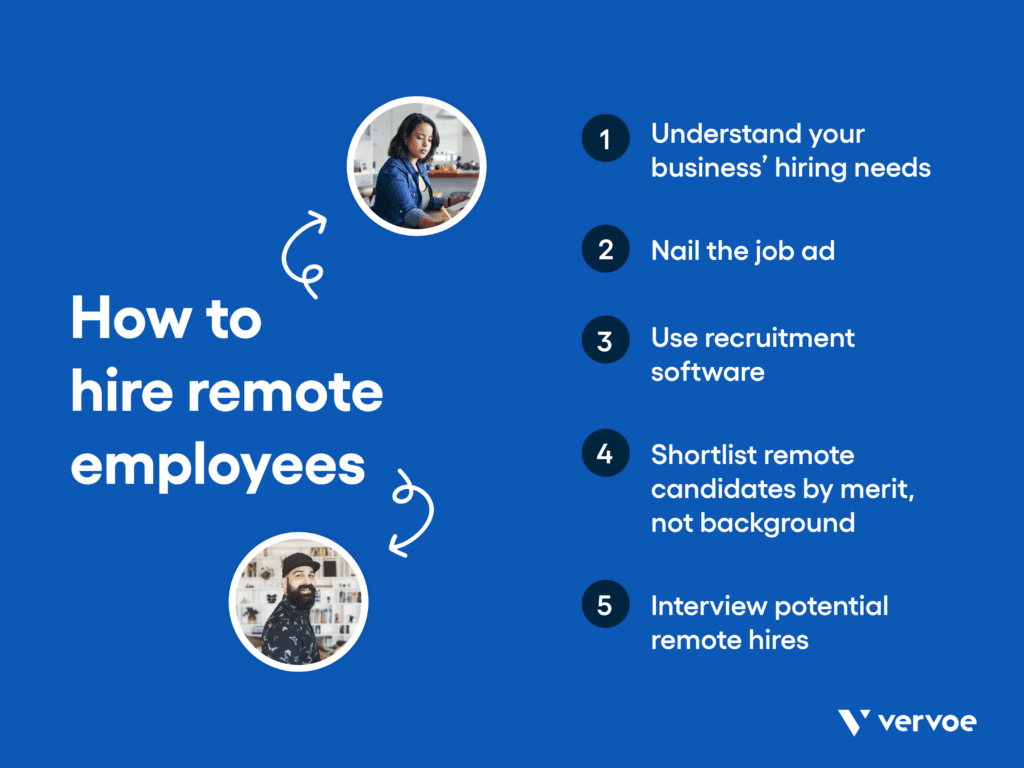
Follow this five-step remote job hiring process to successfully hire for remote teams.
1. Understand your business’ hiring needs
The more time invested at this stage, the better chances you’ll have of reaching a great hiring outcome. Speak with the hiring manager and other stakeholders to gain a thorough understanding of the role and its requirements. Be sure to consider how the role fits within your organization’s overall People strategy.
2. Nail the job ad
Don’t rush the job ad. Avoid jargon, buzzwords, and don’t be tempted to simply copy and paste the ad from the last time the position was vacant.
Ensure it includes everything a candidate needs to know and inspires them to take the next step, but don’t be too detailed as this can turn people away. Similarly, don’t be too vague.
Be targeted when placing the job ad online to get the best value for your advertising budget and get the information in front of the right people.
3. Use recruitment software
Seriously, we’re no longer in the 1990s. Attempting to manage a hiring process for remote jobs using email and spreadsheets is incredibly inefficient. There are hundreds of excellent recruitment and workflow tools on the market to choose from, many of which integrate seamlessly with Vervoe.
When choosing the best recruitment software for your business, look for features such as email automation, ad publishing, video communication, in-app messaging, candidate relationship management, skill testing, and a reporting and analysis function.
4. Shortlist remote candidates by merit, not background
You could sift through hundreds of résumés to build a shortlist, but this creates the following issues:
- The best résumé-writers aren’t necessarily the best candidates.
- Not everyone tells the truth in their resumes.
- Résumés omit negative information.
- Résumés introduce another opportunity for unconscious biases in the hiring process.
- Requiring an updated résumé lowers the number of applications.
- Résumés are focused on background and experience rather than quantifiable skills
Instead, skip the résumé screening process and hire the best person for the job (no matter where they are based) using AI-powered skills testing for remote candidates.
Alongside job-specific technical skills, be sure to test for soft skills that remote employees need to have, such as communication, collaboration, and the unique traits required to work remotely, like self-motivation.
5. Interview potential remote hires
If you have already conducted an online skills assessment, you should have confidence that all of your shortlisted candidates can do the job. This will remove the need to waste time in an interview trying to unearth whether or not the candidate possesses various skills.
Instead, an online interview can be used to explore cultural fit, working style, career goals, and allow the candidate to ask plenty of questions. If the candidate has scored poorly in a particular area of the skills test, use this time to dive deeper into that area and discover why.
It’s also a good idea to ask remote candidates about their readiness to work in a remote role, with questions such as:
- How do you stay motivated without in-person supervision?
- How do you maintain a work/life balance?
- How do you handle distractions when working from home?
As noted above, these interview questions can be combined with elements of the skills test measuring remote working skills such as communication and collaboration.
An online interview can be conducted using several different types of technology. The most common methods are:
- Live video calls using platforms such as Zoom or Microsoft Teams are the most common method of conducting online interviews.
- Pre-recorded videos, also known as a one-way video interview, involve candidates recording their answers to a series of interview questions. This could include the video element of an online skills assessment.
- Video resumes, in which candidates create an ‘elevator pitch’ or job audition-style video showcasing their background and skills.
- Live chat using WeChat, WhatsApp, Facebook Messenger, and similar platforms for a text-based back-and-forth.
- Chatbots can help automate the application process and are particularly useful in high-volume situations.
Remote hiring software
The other key difference between traditional and remote recruitment is the central role played by technology, and (more specifically) by remote hiring tools. Most companies use an Applicant Tracking System (ATS) to manage the end-to-end process from sourcing through to onboarding remote talent.
Digital tools that enable remote hiring (and may or may not be included within an ATS) include automated job ad placement, video interviewing, background checking, skills assessment tools (like Vervoe), onboarding, and paperless capabilities such as digital signatures.
The great news is that there has recently been an explosion in the number of remote recruitment software offerings on the market, with dozens of digital solutions available to support every step of the remote work hiring process.
How to retain remote employees
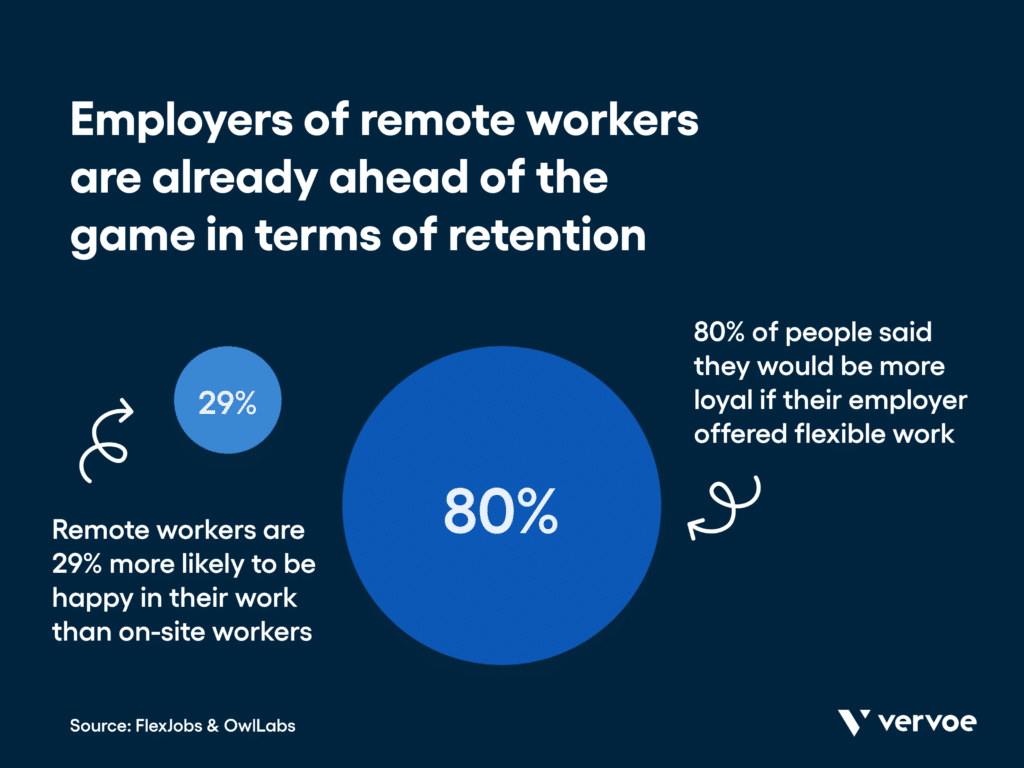
The great news is that employers of remote workers are already ahead of the game in terms of retention. A FlexJobs survey found that 80% of respondents said they would be more loyal to their employer if they offered flexible work, while OwlLabs found that remote workers are 29% more likely to be happy in their work than on-site workers.
But flexibility isn’t enough to ensure a low turnover of remote employees. Some strategies to drive retention include:
- Hiring the best-fit candidates using a combination of skills testing and interviewing.
- Creating a culture of reward and recognition – there are plenty of software options to support remote recognition.
- Offer location-based compensation that accounts for differences in cost-of-living from country to country.
- Offer benefits that will help remote workers, such as an attractive vacation plan, health, life insurance, access to a coworking space, and professional development (training).
- Ensure remote workers have the same career growth opportunities as on-site employees. Avoid the “out of sight, out of mind” trap by making sure remote workers have the same training, mentorship, bonuses, and (most importantly) promotion opportunities as their in-office colleagues.
- Make regular feedback sessions part of your routine with remote workers to ensure good work is recognized and drive continuous improvement.
Remote Hiring FAQs
Is remote time-to-hire faster than traditional hiring?
Something to be aware of is that you can expect a dramatic increase in applications for remote jobs as candidates from all over the world apply, even though the majority may be unqualified. It’s therefore important to set up automated screening processes, including skill assessments.
Does remote hiring lead to better-quality candidates?
Do candidates prefer an in-person or remote hiring experience?
Just as with in-person hiring, one of the main drivers of a positive experience is frequent interaction and plenty of information for candidates who despise being “ghosted”. Most recruitment technology solutions enable the creation of automated communications that will keep the candidate thoroughly informed at every step of the process.
Keep in mind that a candidate’s confidence and acceptance of the remote hiring process will indicate how they would fare working remotely in general.
Three considerations when hiring a remote team
1. Focus on creating a great candidate experience
Remote hiring shouldn’t mean a sub-standard experience for candidates. On the contrary, recruitment technology can be used to create a great remote hiring experience, even for unsuccessful candidates.
2. Test a mix of technical and soft skills
If you’re hiring a coding expert, don’t just test their coding skills. Be sure to test their soft skills such as problem-solving, adaptability, teamwork, time-management, and communication skills – many of which are vital for working remotely.
3. Use technology to minimize inherent bias
Hiring someone remotely creates an opportunity to use diversity and inclusion software to make data-driven hiring decisions based on skill, not on inherent biases.
Hire remote teams with ease using Vervoe
Vervoe’s AI-powered remote recruiting software makes it simple to hire global team members, find people with the right skills for remote work, and create a great remote hiring experience for candidates.